تہجد نماز کا طریقہ، وقت اور رکعات
Tahajjud namaz ka tarika is simple: after sleeping, wake before Fajr and pray voluntary prayers two rakats at a time. It is the most virtuous prayer after the farz, prayed in the quiet hours when, as the Prophet ﷺ told us, Allah calls out to those who ask of Him.
Allah told the Prophet ﷺ: "And from the night, wake for it as an additional prayer for you" (Quran 17:79), and praises "those who forsake their beds to call on their Lord in fear and hope" (Quran 32:16). The Prophet ﷺ said: "Every night when the last third of the night remains, our Lord descends to the nearest heaven and says: Who is calling Me, that I may answer him? Who is asking of Me, that I may give him? Who is seeking My forgiveness, that I may forgive him?" (Sahih al-Bukhari 1145).
The Prophet ﷺ also said: "The best prayer after the obligatory prayers is the prayer at night" (Sunan an-Nasa'i 1614, sahih).
Tahajjud can be prayed any time after Isha until Fajr begins, but the best time is the last third of the night.
Example (Lahore, October): Maghrib 5:40 PM to Fajr 4:40 AM is 11 hours. One third is 3 hours 40 minutes, so the last third begins around 1:00 AM.
Get tonight's Maghrib and Fajr: Lahore · Karachi · Islamabad · Rawalpindi · London · all cities.
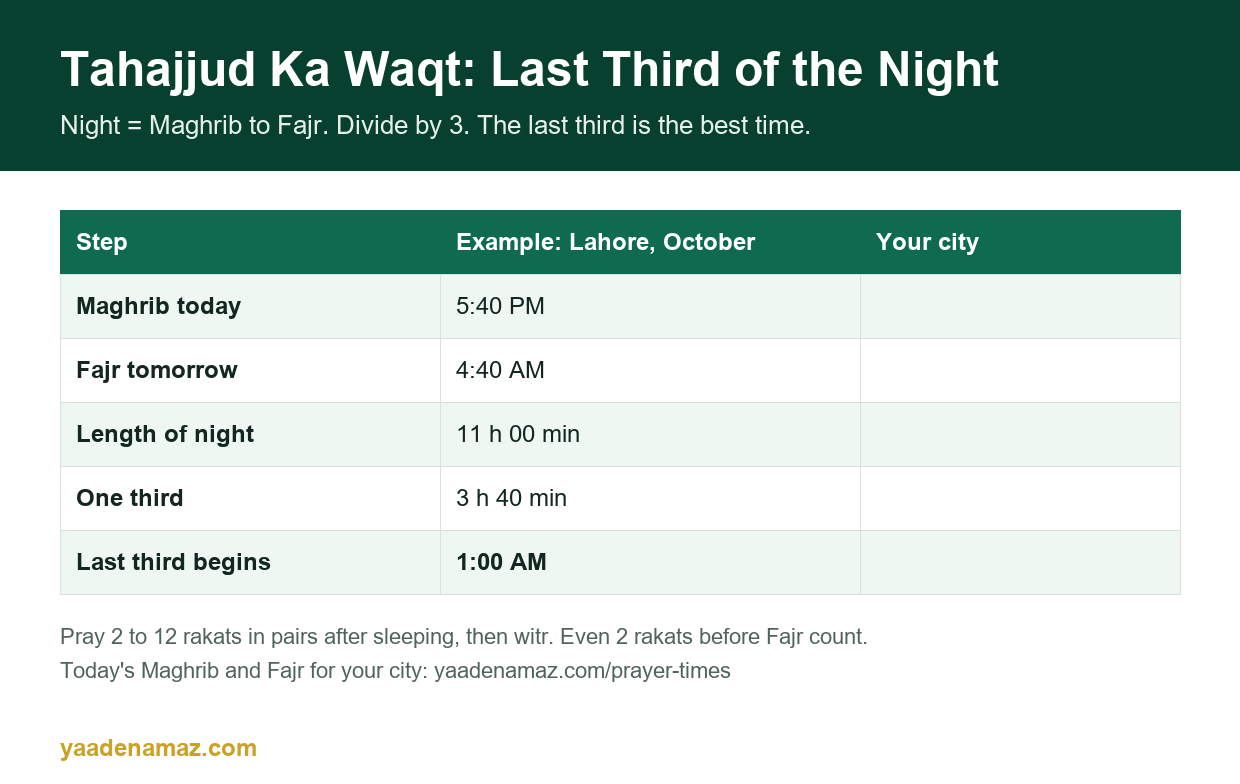
Download the chart as PDF · print it and keep it at your prayer place.
| Season | Maghrib | Fajr | Last third begins |
|---|---|---|---|
| Winter (December) | about 5:15 PM | about 5:40 AM | about 1:35 AM |
| Spring (March) | about 6:15 PM | about 5:00 AM | about 1:25 AM |
| Summer (June) | about 7:20 PM | about 3:30 AM | about 0:45 AM |
| Autumn (October) | about 5:40 PM | about 4:40 AM | about 1:00 AM |
In summer the nights are short, so the last third starts earlier and lasts less than three hours. Use today's times for the exact minutes.
There is no fixed number. Pray 2, 4, 6, 8 or up to 12 rakats, two at a time. Aisha said the Prophet ﷺ "never prayed more than eleven rak'ahs, in Ramadan or outside it" (Sahih al-Bukhari 1147): usually 8 of tahajjud and 3 of witr. Even 2 rakats before Fajr count as tahajjud.
Any. Recite what you know, slowly; longer surahs if you have memorised them. Many read the last part of Surah Al-Baqarah, Surah Al-Mulk or Surah Yaseen.
Ibn Abbas said that when the Prophet ﷺ got up at night for tahajjud he said: Allahumma lakal-hamd, Anta qayyimus-samawati wal-ardi wa man fihinna, wa lakal-hamd, laka mulkus-samawati wal-ardi wa man fihinna, wa lakal-hamd, Anta nurus-samawati wal-ard... "O Allah, all praise is Yours; You are the Sustainer of the heavens and the earth and all that is in them; all praise is Yours; Yours is the dominion of the heavens and the earth and all that is in them; all praise is Yours; You are the Light of the heavens and the earth..." (Sahih al-Bukhari 1120, read the full dua there).
Tahajjud is the best time to ask Allah for anything: a job, a cure, a marriage, guidance. Pray your rakats, then make dua in sajdah (in your own words in nafl prayer) and after salam, with durood at the start and end, and with certainty that Allah hears. For a decision between options, pray istikhara.
Yes, if you are sure you will wake for Fajr; otherwise stay up until Fajr.
Tahajjud is nafl, so it has no qaza, but praying extra in the morning when you missed it is from the Sunnah.
Many Hanafi scholars say tahajjud is the prayer after waking from sleep, even a short nap. Nafl prayed after Isha without sleeping is still rewarded as night prayer (qiyam al-layl).
No. Tahajjud is prayed after Isha.
Yes, in the same way, except during menstruation.
No. It is a highly emphasised voluntary prayer (sunnah) for the ummah.
Start with just 2 rakats twenty minutes before Fajr, then pray Fajr on time. Small and constant is beloved to Allah.
Prayer times, reminders on WhatsApp, Quran and Hadith in one free app.