نماز کا طریقہ مکمل، مردوں کے لیے
Namaz ka tarika is the same for every prayer; only the number of rakats changes. This step-by-step guide follows the Hanafi method for men, with every word you say in Arabic, transliteration and meaning. Women: see the differences in aurat ki namaz ka tarika.
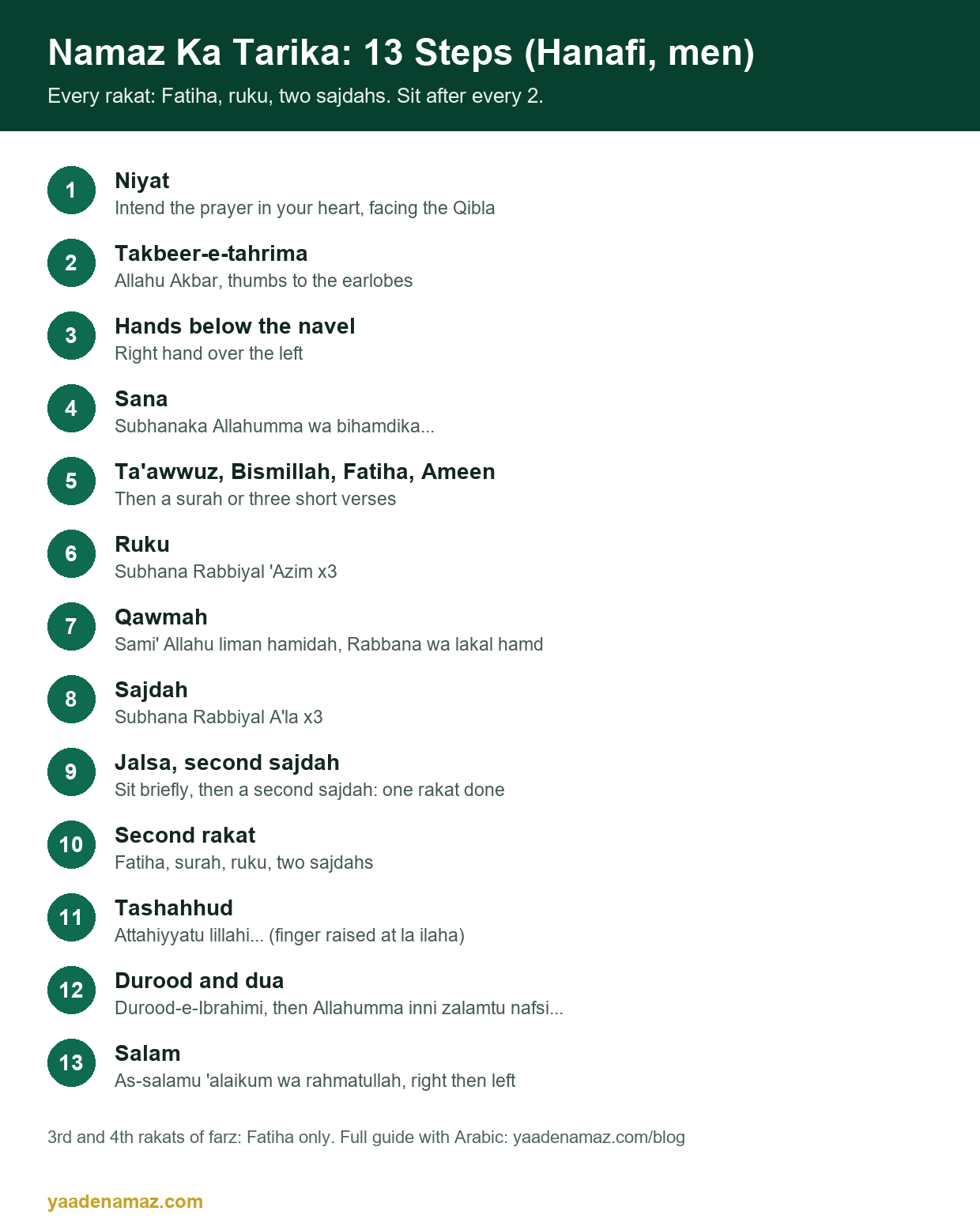
Download the chart as PDF · print it and keep it at your prayer place.
Stand facing the Qibla with your feet about four fingers apart. Intend in your heart which prayer you are praying, e.g. "4 rakats farz of Zuhr, for Allah". Saying it is optional.
Raise both hands so the thumbs touch the earlobes, palms facing the Qibla, and say:
اللهُ أَكْبَرُ
Allahu Akbar (Allah is the Greatest). Then fold your hands below the navel, right hand over the left, holding the left wrist.
سُبْحانَكَ اللَّهُمَّ وَبِحَمْدِكَ، وَتَبارَكَ اسْمُكَ، وَتَعَالَى جَدُّكَ، وَلاَ إِلَهَ غَيْرُكَ
Subhanaka Allahumma wa bihamdika, wa tabarakasmuka, wa ta'ala jadduka, wa la ilaha ghayruk. "How perfect You are, O Allah, and I praise You. Blessed is Your name, exalted is Your majesty, and there is no god but You."
Say quietly A'udhu billahi minash-shaitanir-rajim and Bismillahir-Rahmanir-Rahim, then recite Surah Al-Fatiha, say Ameen quietly, and recite another surah or at least three short verses (for example Surah Al-Ikhlas or any of the 4 Qul).
Say Allahu Akbar and bow, holding your knees with fingers spread, back and head level. Say three times:
سُبْحانَ رَبِّيَ الْعَظِيمِ
Subhana Rabbiyal 'Azim (How perfect is my Lord, the Magnificent).
Rise saying:
سَمِعَ اللَّهُ لِمَنْ حَمِدَهُ
Sami' Allahu liman hamidah (Allah hears the one who praises Him), and once upright: Rabbana wa lakal hamd (Our Lord, all praise is Yours). Stand still for a moment.
Say Allahu Akbar and go down: knees first, then hands, then nose and forehead, between your hands. Keep your arms off the ground and away from your sides, and toes pointing to the Qibla. Say three times:
سُبْحَانَ رَبِّيَ الأَعْلَى
Subhana Rabbiyal A'la (How perfect is my Lord, the Most High).
Sit up saying Allahu Akbar, sitting on your left foot with the right foot upright. Pause, then make the second sajdah the same way. This completes one rakat.
Stand up with Allahu Akbar and repeat Fatiha, a surah, ruku and two sajdahs (no sana or ta'awwuz this time).
After the second sajdah of the 2nd rakat, sit and recite the tashahhud:
التَّحِيَّاتُ لِلَّهِ، وَالصَّلَواتُ، وَالطَّيِّباتُ، السَّلاَمُ عَلَيْكَ أَيُّهَا النَّبِيُّ وَرَحْمَةُ اللَّهِ وَبَرَكَاتُهُ، السَّلاَمُ عَلَيْنَا وَعَلَى عِبَادِ اللَّهِ الصَّالِحِينَ. أَشْهَدُ أَنْ لاَ إِلَهَ إِلاَّ اللَّهُ وَأَشْهَدُ أَنَّ مُحَمَّداً عَبْدُهُ وَرَسولُهُ
At-tahiyyatu lillahi was-salawatu wat-tayyibat, as-salamu 'alaika ayyuhan-nabiyyu wa rahmatullahi wa barakatuh, as-salamu 'alaina wa 'ala 'ibadillahis-salihin. Ash-hadu an la ilaha illallah wa ash-hadu anna Muhammadan 'abduhu wa rasuluh. Raise the right index finger at "la ilaha" and lower it at "illallah".
In the last sitting, after the tashahhud:
اللَّهُمَّ صَلِّ عَلَى مُحَمَّدٍ، وَعَلَى آلِ مُحَمَّدٍ، كَمَا صَلَّيتَ عَلَى إِبْرَاهِيمَ، وَعَلَى آلِ إِبْرَاهِيمَ، إِنَّكَ حَمِيدٌ مَجِيدٌ، اللَّهُمَّ بَارِكْ عَلَى مُحَمَّدٍ وَعَلَى آلِ مُحَمَّدٍ، كَمَا بَارَكْتَ عَلَى إِبْرَاهِيمَ وَعَلَى آلِ إِبْرَاهِيمَ، إِنَّكَ حَمِيدٌ مَجِيدٌ
A dua the Prophet ﷺ taught Abu Bakr to say in his prayer (Sunan Ibn Majah 3835, sahih):
اللَّهُمَّ إِنِّي ظَلَمْتُ نَفْسِي ظُلْماً كَثِيراً، وَلاَ يَغْفِرُ الذُّنوبَ إِلاَّ أَنْتَ، فَاغْفِرْ لِي مَغْفِرَةً مِنْ عِنْدِكَ وَارْحَمْنِي، إِنَّكَ أَنْتَ الغَفورُ الرَّحيمُ
Allahumma inni zalamtu nafsi zulman kathiran, wa la yaghfirudh-dhunuba illa anta, faghfir li maghfiratan min 'indika warhamni, innaka antal-Ghafurur-Rahim.
Turn your face to the right saying As-salamu 'alaikum wa rahmatullah, then to the left saying the same. Your namaz is complete. Then read the duas after salah, such as Ayat ul Kursi and the tasbeeh 33/33/34.
| Rakat | Farz prayers | Sunnah, nafl and witr |
|---|---|---|
| 1st | sana, Fatiha + surah | sana, Fatiha + surah |
| 2nd | Fatiha + surah, then first sitting | Fatiha + surah, then sitting |
| 3rd | Fatiha only | Fatiha + surah |
| 4th | Fatiha only, then last sitting | Fatiha + surah, then last sitting |
You can begin praying today, even before you know everything by heart. Learn in this order:
Until you have learned the longer parts, pray in congregation where you can, so you follow the imam, and keep practising a few lines every day.
A prayer is only valid if these are met before you begin (Hanafi):
| Condition | What it means |
|---|---|
| Taharat of the body | wudu (and ghusl if required) |
| Clean clothes | free of najasat (impurity) |
| Clean place | where you stand, kneel and prostrate |
| Satr | men: navel to below the knees covered |
| Time | the prayer's time has begun |
| Qibla | facing the direction of the Kaaba |
| Niyat | intending the specific prayer |
Missing any of these, even by mistake, means the prayer must be repeated (sajda sahw can't fix it): takbeer-e-tahrima, qiyam (standing), qira'at (recitation), ruku, both sajdahs, and the last sitting for the length of the tashahhud. Wajib acts (like Fatiha, the first sitting, or the surah after Fatiha) are fixed with sajda sahw if missed by mistake.
Sana, ta'awwuz and bismillah, Fatiha, a surah, the tasbeeh of ruku and sajdah, tashahhud, durood-e-Ibrahimi, a dua, and salam.
No, the niyat is in the heart. Saying it is permitted but not required.
In the Hanafi school, below the navel, right hand over the left.
No. The recitation and the fixed words of namaz are in Arabic. You may make personal dua in your own language outside the prayer, and in your heart during sajdah of nafl prayers.
In the Hanafi school, only at the first takbeer (and at the qunoot takbeer of witr and the extra takbeers of Eid).
At least long enough to say "Subhana Rabbiyal 'Azim" or "Subhana Rabbiyal A'la" three times calmly.
Learn one step a day, starting with Fatiha and the short surahs, and pray every namaz on time. Turn on prayer time reminders so you never miss the start of a prayer.
Prayer times, reminders on WhatsApp, Quran and Hadith in one free app.