عورت کی نماز کا طریقہ
Aurat ki namaz ka tarika is the same as a man's in everything that is said, and in the number of rakats. In the Hanafi school, a woman's postures are more covered and compact. This guide walks through every step and marks the differences clearly.
Make the niyat in your heart. Raise your hands, without taking them out from under the dupatta, to the shoulders, and say Allahu Akbar.
Place the hands on the chest, right palm on the back of the left hand (Hanafi; men place them below the navel).
سُبْحانَكَ اللَّهُمَّ وَبِحَمْدِكَ، وَتَبارَكَ اسْمُكَ، وَتَعَالَى جَدُّكَ، وَلاَ إِلَهَ غَيْرُكَ
Then A'udhu billah, Bismillah, Surah Al-Fatiha, Ameen, and a short surah. Recitation is quiet: women do not recite aloud.
Bend only slightly, enough for the hands to reach the knees, fingers together, arms close to the sides. Say Subhana Rabbiyal 'Azim three times.
سُبْحانَ رَبِّيَ الْعَظِيمِ
Rise with Sami' Allahu liman hamidah, then Rabbana wa lakal hamd, and stand still for a moment.
Go down keeping the body compact: stomach against the thighs, arms resting on the ground beside the body, and both feet out to the right side. Say Subhana Rabbiyal A'la three times.
سُبْحَانَ رَبِّيَ الأَعْلَى
Sit between the sajdahs on the left hip with both feet out to the right, then make the second sajdah. That is one rakat.
Sit the same way, on the left hip with both feet to the right, hands on the thighs with the fingers together, and recite the tashahhud:
التَّحِيَّاتُ لِلَّهِ، وَالصَّلَواتُ، وَالطَّيِّباتُ، السَّلاَمُ عَلَيْكَ أَيُّهَا النَّبِيُّ وَرَحْمَةُ اللَّهِ وَبَرَكَاتُهُ، السَّلاَمُ عَلَيْنَا وَعَلَى عِبَادِ اللَّهِ الصَّالِحِينَ. أَشْهَدُ أَنْ لاَ إِلَهَ إِلاَّ اللَّهُ وَأَشْهَدُ أَنَّ مُحَمَّداً عَبْدُهُ وَرَسولُهُ
In the last sitting add durood-e-Ibrahimi and a dua, then end with salam to the right and left, exactly as in namaz ka tarika step by step.
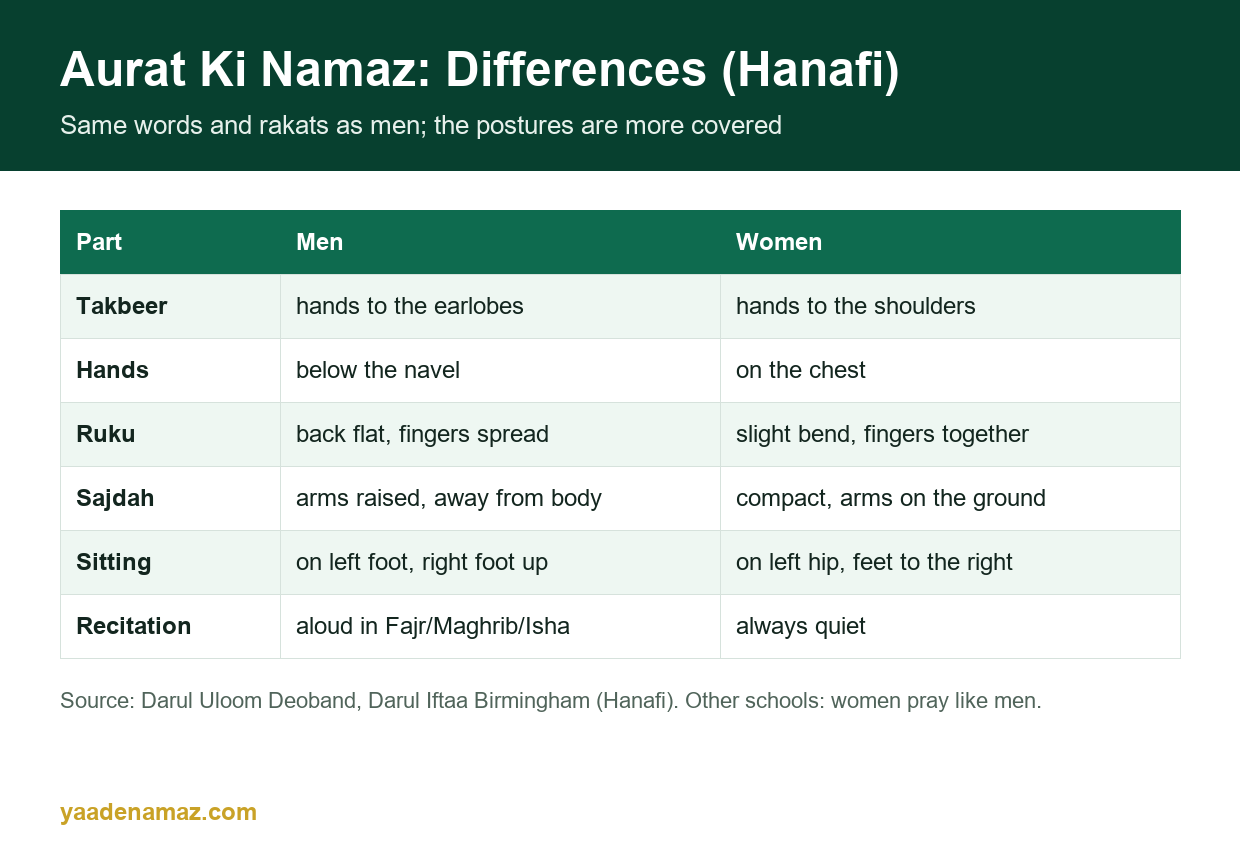
Download the chart as PDF · print it and keep it at your prayer place.
| Part | Men (Hanafi) | Women (Hanafi) |
|---|---|---|
| Takbeer | hands to the earlobes | hands to the shoulders, under the dupatta |
| Hands | below the navel | on the chest |
| Ruku | back flat, fingers spread | slight bend, fingers together |
| Sajdah | arms raised, away from the body | compact, arms on the ground |
| Sitting | on the left foot, right foot upright | on the left hip, feet to the right |
| Recitation | aloud in Fajr, Maghrib, Isha (if imam) | always quiet |
In the Hanafi school a woman's whole body is satr in prayer except the face, the hands (up to the wrists) and the feet. So:
If a quarter of a satr part (for example a quarter of the forearm, or of the hair) stays uncovered for the time it takes to say "Subhan Allah" three times, the prayer is broken and must be repeated.
Women may attend the masjid, especially in Ramadan and for Eid, in a separate, covered area. Praying at home has full reward, and many scholars say it is better for a woman. Women praying together at home may pray in congregation, with the woman leading standing in the middle of the first row.
Namaz becomes farz when a girl reaches puberty (the start of her periods, or at the latest age 15). Parents should teach it earlier: the Prophet ﷺ said, "Command your children to pray when they are seven years old" (Sunan Abu Dawud 495, hasan sahih). Teaching girls the covered postures from the start makes them natural for life.
These differences are the position of the Hanafi school: the principle, as Darul Uloom Deoband explains, is that a woman does whatever is more concealing for her, based on narrations from the Companions and early scholars. Many scholars of the other schools hold that women pray in the same postures as men. Follow the teaching of your madhab; either way the prayer is valid.
The words and rakats are the same. In the Hanafi school the postures differ to keep the body more covered, as in the table above.
Yes. Women are not required to pray in the masjid, and praying at home is fully rewarded.
No. Those prayers are forgiven and not made up (missed fasts are made up).
Normal nail polish stops water reaching the nails, so wudu, and therefore the prayer, is not valid while it is on. Remove it before wudu. Henna (mehndi) is fine.
The satr must be covered with clothing that hides the colour of the skin and does not cling to the body. A loose chador or long dupatta over the clothes is best.
In the Hanafi school, on the chest, right hand over the left.
Learn the words once, practise the postures for a few days, and your namaz will feel natural. Prayer reminders help you pray every one on time.
Prayer times, reminders on WhatsApp, Quran and Hadith in one free app.